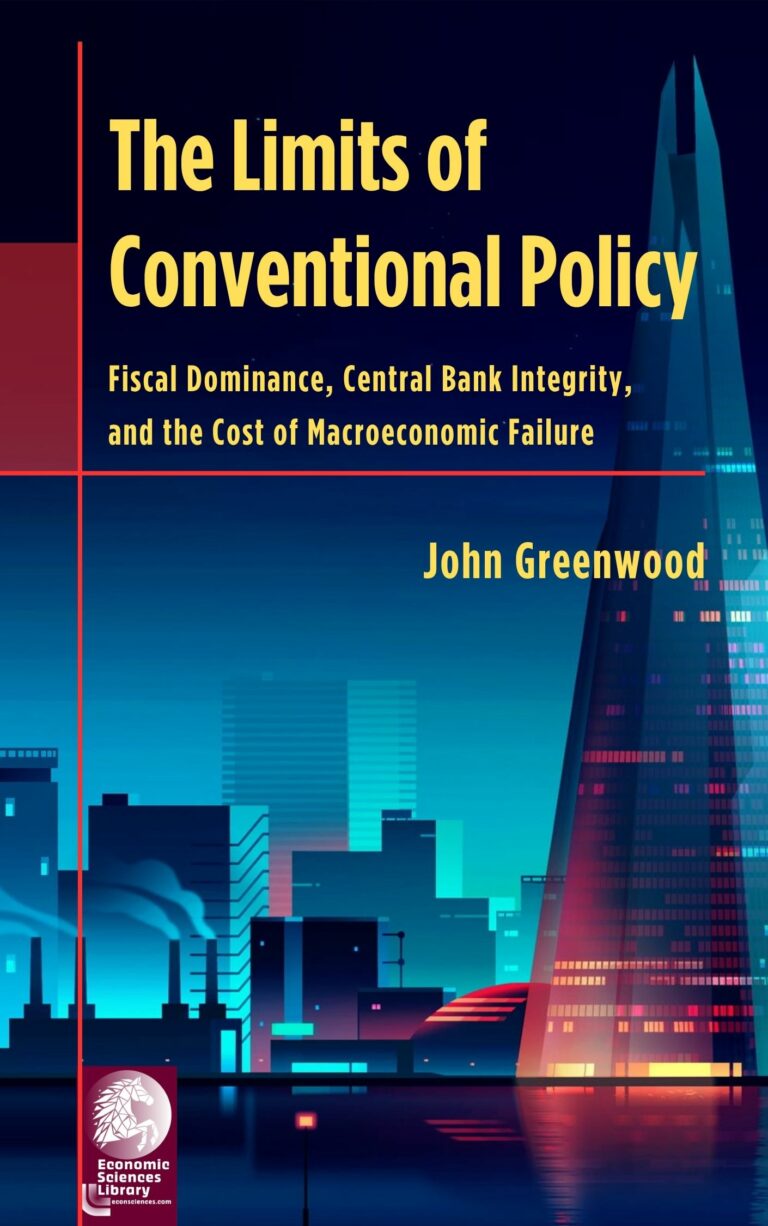
This book focuses on the most critical challenge in modern macroeconomic management: the helplessness of conventional monetary and exchange rate policies against deeply rooted fiscal imbalances and institutional crises of credibility. In an era where financial crises, instability, and persistent inflation continue to plague the global economy, this collection uses four distinct case studies to examine the traps policy makers frequently fall into and the radical institutional reforms required to escape them. The core thesis of the book is that the power of policy tools is only as strong as the independence of the institutions that implement them and their relationship with fiscal discipline.
The last fifteen years ushered in an era where Central Banks (CBs) employed historically unconventional tools. Following the 2008-09 Global Financial Crisis, Quantitative Easing (QE) became the primary instrument in an environment where traditional interest rate policy proved inadequate. However, our first paper demonstrates that these tools are not homogenous and that their implementation dramatically alters the outcomes. QE operations implemented by the Federal Reserve (Fed) and the Bank of England (BoE) were consistent with an expansion of deposits in the banking system and a reduction of non-bank private sector leverage, promoting a gradual normalization of growth, interest rates, and inflation. In contrast, the operations of the Bank of Japan (BoJ) and the European Central Bank (ECB) failed to yield the same results. This proves that it is not just the magnitude of QE, but how it affects the credit transmission mechanism, that is critical. For monetary expansion to succeed, it must not only inject money into the system but also improve the risk and leverage structure of the private sector. The failures in Japan and the Eurozone indicate that expansion was insufficient to overcome structural impediments, and these policies alone could not deliver the promise of generating demand or normalizing inflation.
The dilemmas of monetary and exchange rate policies are not limited to the post-crisis era; they are historical patterns. Our second paper draws a striking comparison between China today and Japan in the 1920s, illustrating how the obsession with an overvalued exchange rate and external surplus destabilizes an economy. Similar to Japan's experience after WWI, when large external surpluses drove up domestic prices to uncompetitive levels, China’s fixed-rate policy and huge external surplus accumulation following the 1994 exchange rate reunification led to non-competitive domestic pricing. In 1920s Japan, this resulted in a decade of financial crises, slow growth, agricultural depression, and deflation, only resolved by a radical devaluation in 1931. This paper showcases the cost of turning exchange rate policy into a political fetish, emphasizing that the refusal of flexibility—despite short-term gains—ultimately sets the stage for long-term economic collapse.
The third and fourth papers of the book focus on Argentina, the most striking and long-lasting example of fiscal indiscipline and central bank abuse. The Argentine case demonstrates how the cycle of successive governments funding budget deficits by relying on the central bank's monetary powers chronically erodes the value of the currency. This cycle has led to persistently rapid broad money growth, high inflation, and a chronically weak peso.
The third paper proposes a radical solution to end this chronic instability loop: the abolition of the BCRA (Central Bank of Argentina) and the Dollarization of the economy. This proposal acknowledges that the root of the problem is not merely economic, but institutional and political. In Argentina, monetary instability has become an established feature of the system, not a deviation. Therefore, it argues that stability can only be achieved by entirely removing monetary policy from the purview of the government and local institutions—i.e., through Dollarization. The paper includes critical technical details for the required practical steps on Dollarization-Day, such as replacing the LELIQs with US$-denominated government securities, managed by a new independent office for Argentine government debt.
The fourth paper analyzes Argentina's struggle with conventional remedies, namely IMF Surveillance. Despite the election of a market-friendly administration (Mauricio Macri), the core problem—the central bank's abuse for fiscal deficit financing—persisted. The IMF's $50 billion Stand-By Agreement (SBA) proposed a gradual reduction of the fiscal deficit and the strengthening of central bank autonomy. However, this paper argues that the IMF plan's assumption of a "painless and recession-free" gradual recovery was unrealistic, deeming the current fiscal and inflation targets unattainable. Consequently, the IMF plan was predicted to fail, leading Argentina either to default on its foreign-denominated debt once more or face financial collapse and high unemployment, virtually ensuring a return to populism for another decade. This paper underscores the failure of gradualism in an environment where institutional trust has been decimated.
These four papers collectively demonstrate that regardless of geography or time, the fundamental pillars of macroeconomic stability remain constant: sound fiscal policy, a credible institutional framework, and properly designed transmission mechanisms for policy tools. This compilation serves as a call for academics, policymakers, and financial experts to look beyond the policy toolkit and to fundamentally question institutional structures. We hope this book will be a vital resource in the search for bolder, more structural, and less conventional solutions to current challenges.
Preface
1. Why negative rates are not a solution for Japan or the Eurozone
Introduction
Two types of QE policy
Developments on the balance sheets of Eurozone and Japanese Banks
Why poorly designed QE programs have led to negative rates
Conclusion
2. History Rhymes – A Comparison of China Today with Japan in the 1920s
Introduction 20
Japan’s External Disequilibrium in the 1920s
China’s Domestic and External Disequilibria since 1994
Conclusion
3. Dollarize Argentina; Abolish the B.C.R.A.
Introduction
Dismantling the BCRA
Concluding Remarks
4. Prospects for Argentina under IMF Surveillance
Introduction
The Abuse of the Central Bank’s Balance Sheet
Some Symptoms and Consequences of Monetary Mismanagement
Early Stages of the 2018 Crisis
Conclusions
5. Why Fiscal and Phillips Curve Theories of Inflation are not Working
Inflation are not Working
Inflation since the Global Financial Crisis
Two Popular Explanations for Inflation
Popular Explanations for the End of the Business Cycle Expansion
Conclusion
Conclusion
References
John Greenwood
Edinburgh University, UK.
Chief Economist at INVESCO plc, John Greenwood OBE, is a graduate of Edinburgh University. He did economic research at Tokyo University and was a visiting research fellow at the Bank of Japan (1970-74). From 1974 he was Chief Economist with GT Management plc, based initially in Hong Kong and later in San Francisco. As editor of Asian Monetary Monitor he proposed a currency board scheme for stabilizing the Hong Kong dollar in 1983 that is still in operation today. John was a director of the Hong Kong Futures Exchange Clearing Corporation (1987-91) and council member the Stock Exchange of Hong Kong (1992-93). An economic adviser to the Hong Kong Government (1992-93), he has been a member of the Committee on Currency Board Operations of the Hong Kong Monetary Authority since 1998. He is also a member of the Shadow Monetary Policy Committee in England. John is a director of INVESCO Asia Ltd in Hong Kong, INVESCO Asset Management Singapore Ltd, and the Hong Kong Association in London.
In 1980 he translated Yoshio Suzuki’s book, “Money and Banking in Contemporary Japan” from Japanese. In 2007 he completed a book entitled Hong Kong’s Link to the US Dollar: Origins and Evolution which covers the collapse of the currency in 1983 and its subsequent restoration to stability under the plan he devised.


 This Book is completely open access. You can freely read, download and share with everyone.