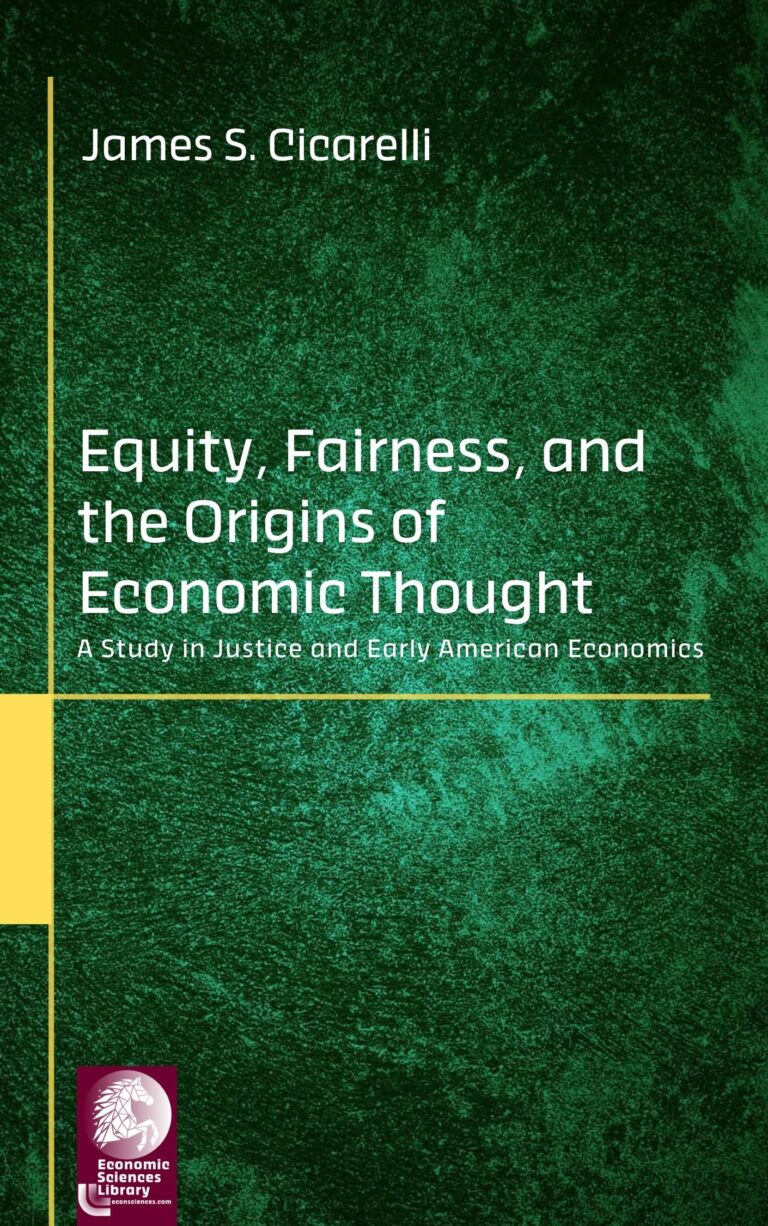
James S. Cicarelli (1941-2023) devoted his career to understanding the moral, philosophical, and historical foundations of economic life. As a long-time faculty member and former dean at Roosevelt University, he was widely admired for his remarkable clarity of thought, generosity toward students, and unwavering commitment to intellectual fairness. His scholarship ranged across the history of economic thought, income distribution, and the philosophical roots of American economic ideas. Yet what distinguished him most was his ability to weave together economic theory, historical narrative, and ethical reflection in a manner accessible, humane, and deeply insightful. This volume, Equity, Fairness, and the Origins of Economic Thought, brings together three of his important contributions that were previously published in EconSciences journals, now presented in unified form to honor his lasting scholarly legacy.
The first essay, Equality, Equity, and the Distribution of Income, reflects Cicarelli’s lifelong interest in the conceptual and empirical foundations of distributive justice. In this work, he revisits more than a century of analysis on the Lorenz curve and the Gini ratio, tracing the evolution of modern approaches to measuring inequality. He moves beyond standard metrics by proposing a novel framework for evaluating fairness in income distribution—one that aspires not merely to quantify disparity, but to illuminate the ethical considerations underlying public policy. The essay stands as a testament to his conviction that economics is inseparable from questions of justice, dignity, and social responsibility.
The second essay, Philosophical Origins of Seventeenth-Century American Economic Thought, explores the intellectual roots of Puritan and Quaker contributions to early American economic life. In a period defined by protohistory—where practice far outpaced formal writing—Cicarelli employs inferential historical method to reconstruct economic reasoning from sparse but meaningful textual remains. His analysis reveals why Quaker ideas, despite being less voluminous, ultimately exerted deeper influence on American economic development than the more doctrinal Puritan tradition.
The final essay, Economic Thought in Eighteenth-Century America Prior to Independence, offers a sweeping overview of conditions and ideas shaping colonial economic thinking from 1700 to 1775. Against the backdrop of rapid population growth, rising literacy, and expanding commercial networks, Cicarelli identifies three currents of thought—mainstream, issue-specific, and crosscurrent—that foreshadowed the trajectory of American economics after independence. His narrative demonstrates how intellectual seeds planted in the colonial era cast “long shadows,” preparing the ground for the nation’s later economic identity.
Together, these essays reveal a scholar deeply attuned to the long arc of economic ideas and their enduring moral implications. In collecting them into this volume, we honor James S. Cicarelli not only as an economist, but as a careful historian, a generous teacher, and a voice committed to fairness in both scholarship and society. May this book preserve and extend the influence of his work for future generations of researchers, students, and readers.
Preface
Dedication
1. Equality, equity, and the distribution of income
Knowledge, Ideas, Influence, and Protohistory
A sense of fairness and the distribution of income
Thoughts on the policy implications of an equity approach to income redistribution
2. Philosophical origins of Seventeenth Century American Economic Thought
Knowledge, Ideas, Influence, and Protohistory
Puritan Economic Thought
Another Perspective
3. Economic Thought in Eighteenth Century America Prior to Independence
Economic Conditions, 1700-1775
Eighteenth Century American Economics
Other Voices
A Crosscurrent
References
James Cicarelli
Roosevelt University, USA
James S. Cicarelli was a distinguished American economist whose academic career was closely associated with Roosevelt University, where he served for more than two decades in both administrative and faculty roles. At Roosevelt’s Walter E. Heller College of Business, he first held the position of dean, contributing to the development of business education and academic standards within the college. He later joined the Department of Economics as a senior faculty member, ultimately becoming Professor Emeritus. Throughout his tenure, he was known for his dedication to teaching, his mentorship of students, and his commitment to advancing the study of economics. Even after retirement, he continued to research, write, and publish, reflecting a lifelong engagement with economic scholarship.
Cicarelli’s academic work centered on several interconnected areas, most notably the history of economic thought, income distribution and equity, and the contributions of women economists. He co-authored A History of American Economic Thought: Mainstream and Crosscurrents, a comprehensive study of the evolution of economic ideas in the United States. This book examined both mainstream perspectives and alternative intellectual traditions, demonstrating his interest in presenting a broad and inclusive narrative of American economic thought. Another major contribution was his work on women in economics. His book Distinguished Women Economists, written with Julianne Cicarelli, documented the achievements of women across the discipline and helped highlight their often overlooked role in shaping economic theory and policy. He also authored Joan Robinson: A Bio-Bibliography, providing a detailed scholarly account of one of the most influential heterodox economists of the twentieth century. In addition to his historical and biographical scholarship, Cicarelli wrote on income distribution and fairness, exploring the concepts of equality, equity, and the moral dimensions of economic policy.
James S. Cicarelli’s legacy lies in his multifaceted contributions as a teacher, administrator, historian of economics, and scholar committed to intellectual inclusiveness. His work continues to serve as a resource for students and researchers interested in economic thought, gender in economics, and the ethical foundations of economic policy.

 This Book is completely open access. You can freely read, download and share with everyone.