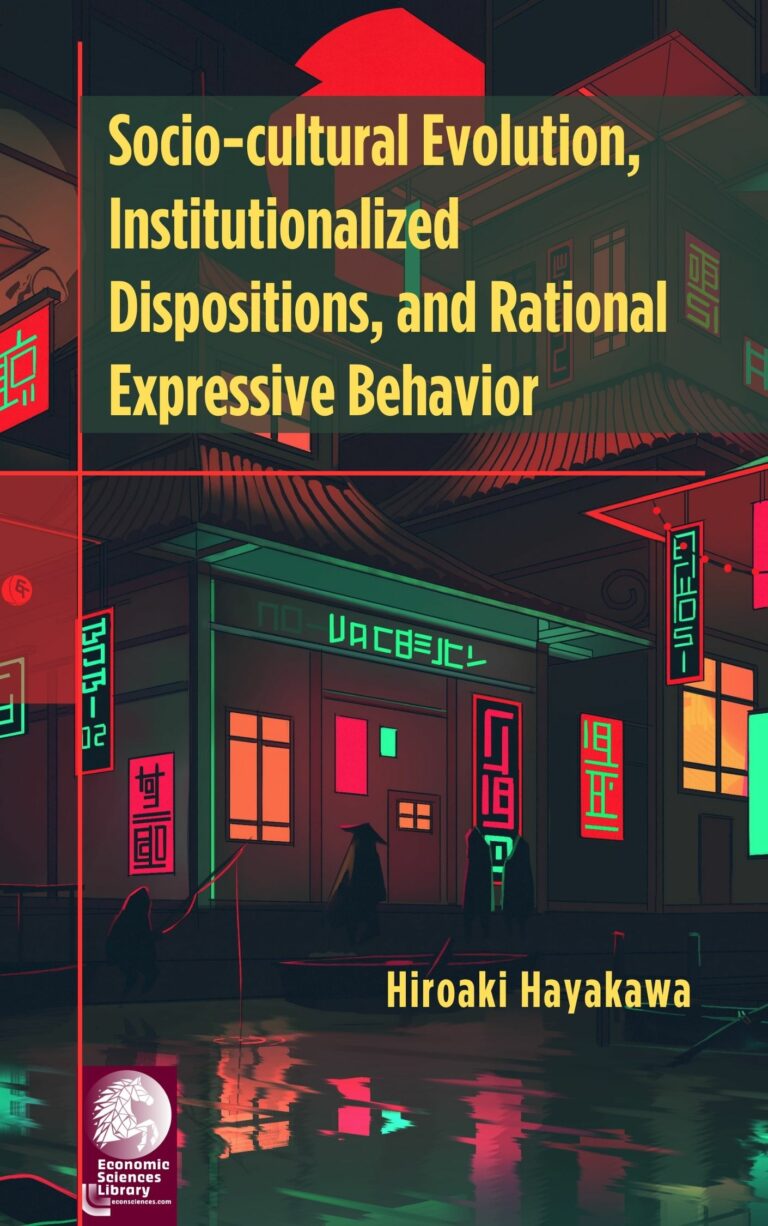
This book focuses on the rationality of expressive behavior of socio-cultural agents and how this behavior is guided by socio-cultural norms and a system of cultural symbolism that evolve over time. Our core objective is to characterize human behavior as an expressive, norm-guided action occurring under conditions of bounded rationality.
Within this framework, we argue that theories of institutionalized dispositions or habitus provide a critical foundation upon which to build our understanding of this behavior as a rational expressive action aimed at attaining symbolic profits. However, this pursuit takes place under several constraints: the feasibility of economic means, the availability of information, the pressure of social sanctions, and the need for psychological satisfaction are all fundamental elements that delimit this rationality.
Specifically, the following crucial points are explored in depth:
The Transformation of Cultural Value Patterns and Norms into Institutionalized Dispositions: The process by which cultural values and norms are internalized at the individual and collective levels and transform into behavioral predispositions, or habitus, is analyzed.
The Evolution and Constitution of the Socio-economic Order: We examine how the socio-economic order emerges and evolves over time, constituted by institutionalized dispositions, the cultural capital of lifestyles, shared expressive symbolism, and social norms.
The Emergence of Social Want: We investigate how social want emerges as a convoluted desire, constituted by both objective social facts and the subjective longing for upper-status identification.
Rational Behavior as the Pursuit of Symbolic Profits: It is demonstrated in detail how behavior based on this social want can be characterized as rational behavior seeking symbolic profits under constraints.
The Relationship with Bounded Rationality: The intricate connection between expressive behavior and the concept of bounded rationality in problem-solving is elucidated.
Our central argument is this: the emergence and evolution of a socio-economic order as a system of cultural symbolism and value patterns occur precisely through expressive behavior based on institutionalized dispositions and bounded rationality. For socio-cultural agents' actions to be meaningful and to achieve symbolic profits, they must be firmly grounded in the surrounding world of a cultural symbolism system. Otherwise, agents would be blind without an external system of visible values and symbolism.
Contrary to the common view that the behavior of socio-cultural agents is too complex to be abstracted as rational behavior, we assert that the pursuit of symbolic profit is just as rational and sensible as the pursuit of economic profit. These two types of profit-seeking—symbolic and economic—are essentially two sides of the same human behavior that seeks to fit itself to the environing world, with "profit" serving as a measure of success in both cases. In both instances, rationality is predicated on the existence of an external, reliable system of information (be it cultural symbolism or market equilibrium prices).
Preface
1. Introduction
2. Adam Smith’s Theory of Moral Sentiments and Cultural Evolution
3. Veblen’s Theory of the Leisure Class: The Canon of Conspicuous Waste
4. Bourdieu’s Logic of Practice: Habitus, Distinction, and the Formation of Lifestyles
5. Parsons’ Vision of Social Actions and Social Systems as an Integrated System
6. Adam Smith, Veblen, and Bourdieu in Relation to One Another from the Parsonian Perspective
7. Social Want and Socio-Economic Rationality
Conclusions
References
Hiroaki Hayakawa
University Brunei Darussalam, Brunei Darussalam.
Born in Japan, educated in the US (high school, university – undergraduate and graduate), BA in mathematics and economics, Ph.D. in economics (University of Michigan). Crossed the Pacific Ocean as an American Field Service student from Japan to the United States, and graduated from Herbert Hoover High School in San Diego, California. The AFS students from around the world had a chance to meet President John F. Kennedy. This marked the beginning of my life and career in the United States. In college, I was interested in philosophy as well as in mathematics and economics, and this interest continues to this day. After getting my Ph.D. from the University of Michigan, I was mainly affiliated with the University of Georgia in Athens, Georgia, where I served as assistant, associate, and full professor. Served also as an interim head of the economics department, as director of graduate studies, as a member of the Executive Council of the College of Business Administration, and as a member of the University Senate. I then moved to Japan and taught at a number of universities, private and national. With this background, I have come to UBD (Universiti Brunei Darussalam), one of the fastest rising universities in Asia, and I am having a great time interacting with the bright minds of Brunei Darussalam. I find the country beautiful and peaceful.


 This Book is completely open access. You can freely read, download and share with everyone.