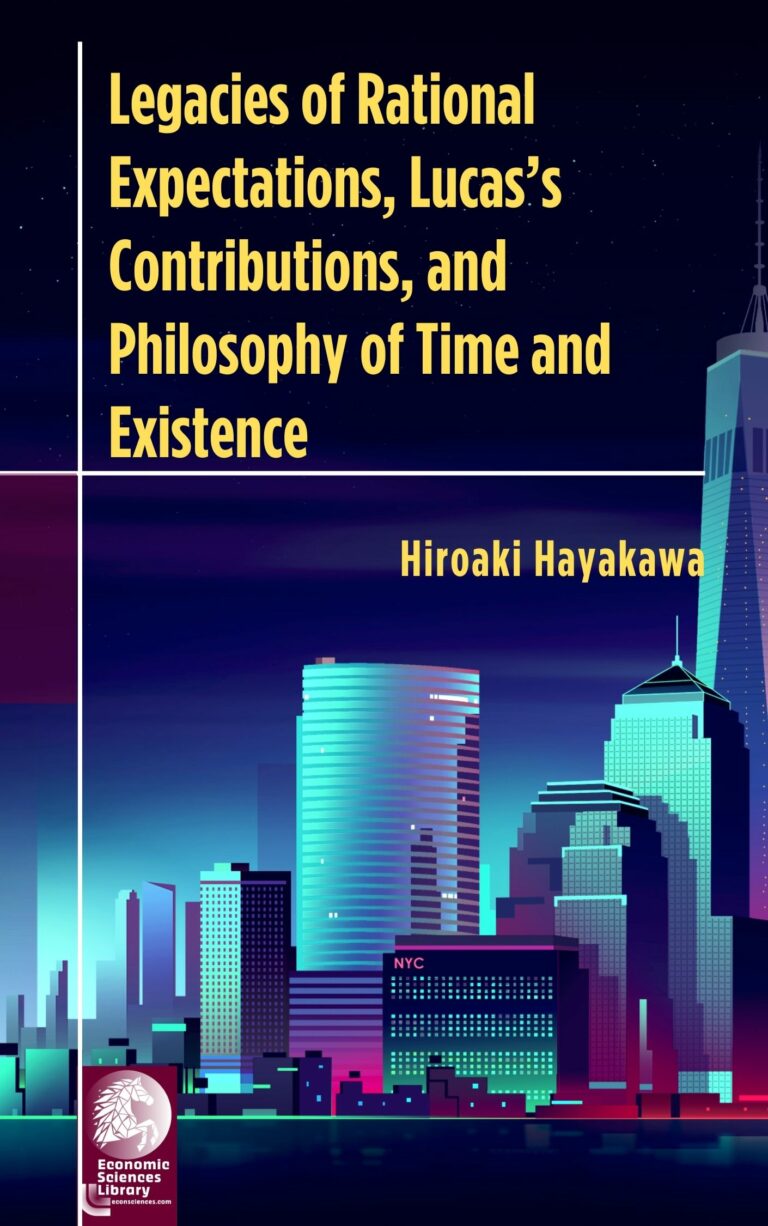
This book investigates the legacy of the rational expectations revolution that swept through economics in the 1960s and 1970s, relating it to an equally revolutionary movement in philosophy that preceded it: the phenomenology of inner time consciousness (Husserl) and human existence (Heidegger).
The Shift from Keynes to Rational Expectations:
We argue that while Keynes's General Theory was a revolution against classical economics, its underlying epistemology was inconsistent with the insights revealed by phenomenology. Keynesianism was met by a counter-revolution known as the theory of rational expectations. The transition involved several key developments:
* Friedman introduced the concept of intertemporal optimization via his permanent income hypothesis, advocating for a unified treatment of consumption, investment, and asset demand.
* Building on Muth's insight that expectations must be rational and consistent with the market's equilibrium information, Lucas unified this consistency with the principle of intertemporal optimization.
This path-breaking epistemology led to a new view of how the economy functions and fundamentally altered the course of economic science and policymaking.
The Philosophical Connection to Phenomenology:
Crucially, we demonstrate that prior to this economic development, a radically new movement in philosophy emerged—the phenomenology of human consciousness and existence—which is intimately connected to the theory of rational expectations and intertemporal optimization.
Specifically, we highlight the connection between:
* Husserl's internal time consciousness (the flux of consciousness as retention of the past, impression of the present, and protention/anticipation of the future).
* Heidegger’s characterization of Dasein (Human Being) as the unified ecstacies of temporality (the inseparability of past, present, and future).
We posit that these philosophical underpinnings parallel the new paradigm of rational expectations theory, which combined intertemporal optimization with market equilibrium conditions.
Rationality, Activity, and Ethics
In establishing this connection, we observe that the basic tenet of rational expectations theory can be viewed as both a radical shift in viewing human activities and, simultaneously, a return to the ethical nature of human existence. This ethical view dates back to Aristotle, who conceived of human existence as a life of activities governed by the virtues of character and intellect.
Ultimately:
* Human activities are interconnected under the unifying virtue of intellect.
* Our understanding of human behavior is incomplete without grasping its relationship to an environing world revealed to us through our own activities.
* Human agents are symbolic and socio-cultural, as well as economic, in their orientation. Rationality makes sense only in reference to a system of cultural symbolism (where symbolic profits are sought) or a system of market prices (where economic profits are sought).
Activities, therefore, unfold as a pairing of what agents seek and the environing world in which this seeking occurs. Essential to profit-seeking is the ability to anticipate what is coming and to fulfill that anticipation through our own activities, which leave traces behind as history. Rationality is the name given to the temporality of human consciousness and existence that discovers an environing world of means, values, and symbols, thereby making profit-seeking possible, meaningful, and fitting to our activities.
Preface
1. Introduction
2. Lucas’s contributions and Aristotle's ethics
3. Husserl’s phenomenology of the consciousness of internal time
4. Heidegger's phenomenology of Dasein
5. The rational expectations equilibrium theory
6. The concept of policy regimes and econometric policy evaluation
7. Monetary theory from Friedman to Lucas
8. Lucas's theory of expectations and the neutrality of money
9. Further discussion of Lucas's contributions in relation to the phenomenologies of consciousness and existence
References
Hiroaki Hayakawa
University Brunei Darussalam, Brunei Darussalam.
Born in Japan, educated in the US (high school, university – undergraduate and graduate), BA in mathematics and economics, Ph.D. in economics (University of Michigan). Crossed the Pacific Ocean as an American Field Service student from Japan to the United States, and graduated from Herbert Hoover High School in San Diego, California. The AFS students from around the world had a chance to meet President John F. Kennedy. This marked the beginning of my life and career in the United States. In college, I was interested in philosophy as well as in mathematics and economics, and this interest continues to this day. After getting my Ph.D. from the University of Michigan, I was mainly affiliated with the University of Georgia in Athens, Georgia, where I served as assistant, associate, and full professor. Served also as an interim head of the economics department, as director of graduate studies, as a member of the Executive Council of the College of Business Administration, and as a member of the University Senate. I then moved to Japan and taught at a number of universities, private and national. With this background, I have come to UBD (Universiti Brunei Darussalam), one of the fastest rising universities in Asia, and I am having a great time interacting with the bright minds of Brunei Darussalam. I find the country beautiful and peaceful.


 This Book is completely open access. You can freely read, download and share with everyone.